Objective Summary: What It Is and How to Write One
Summary
An objective summary is a short, fact-only restatement of a document, report, or meeting that excludes personal opinions and unnecessary detail. Operations teams use them to align shifts quickly, hand off decisions without noise, and feed AI analysis tools with clean inputs. This guide covers the definition, a five-step writing method, common mistakes, and real-world examples across manufacturing, logistics, and software pipelines.
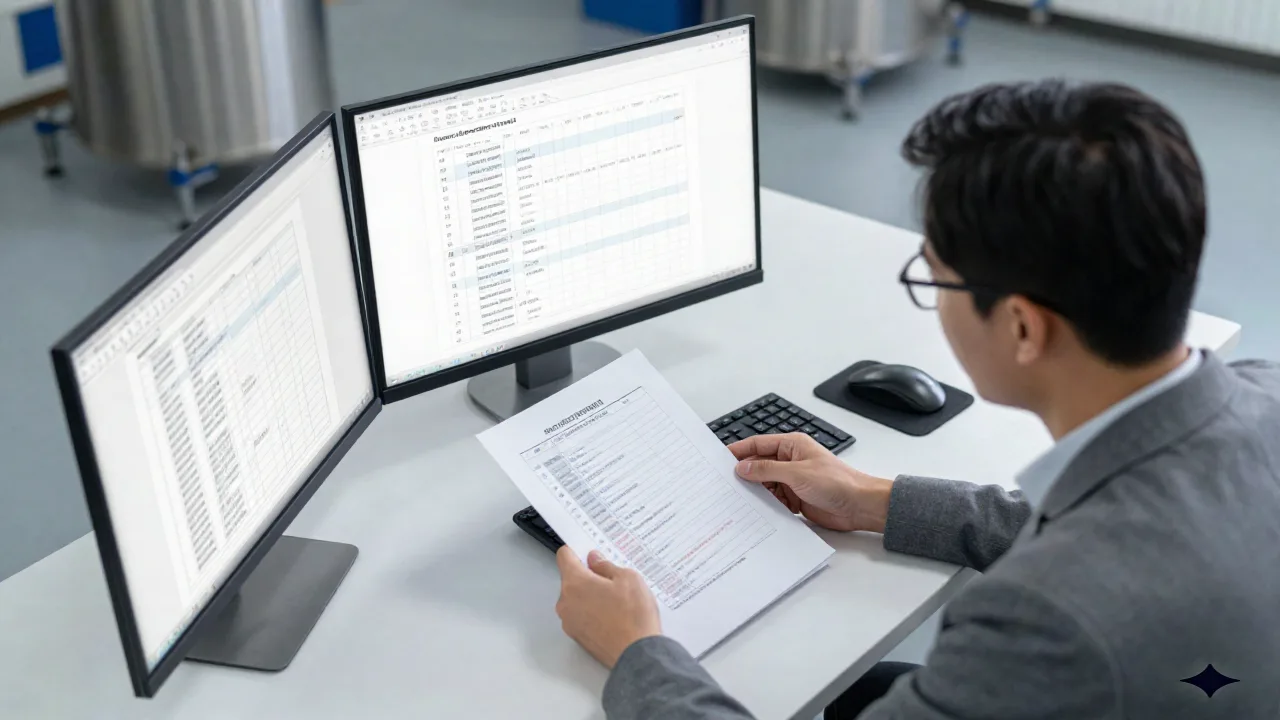
Your line supervisor just handed you a 40-page production report. The shift change is in eight minutes. What you need is not the full document: you need the three numbers that actually matter and the one decision that has to be made before the next crew clocks in. That is the job of an objective summary.
An objective summary is a short, fact-based restatement of a source document, meeting, or process analysis that presents only essential information without personal opinion, interpretation, or filler. In operations contexts (manufacturing lines, fulfillment centers, software pipelines, support queues), objective summaries are the currency of fast, low-friction handoffs.
What Makes a Summary "Objective"?
The word "objective" is doing specific work here. It does not mean "neutral to the point of being useless." It means fact-anchored: every sentence in the summary can be verified against the source material. No phrase like "seems like," "I think," or "it appears" belongs in an objective summary. Neither do adjectives that evaluate rather than describe ("excellent throughput" becomes "throughput of 112 units/hour, 4% above target").
Here is the practical test: if another person reads your summary and cannot tell whether the writer liked or disliked what they read, you have written an objective summary. If they can guess your opinion, you have written a biased one.
This distinction matters more in operations than in almost any other field. When you hand a shift supervisor a summary laced with your interpretation, you have already biased the next eight hours of decisions. The constraining step (the poste limitant that caps your line's throughput) does not care about your feelings; it only responds to accurate data.
The Five-Step Method That Works on the Floor
There is no shortage of five-step frameworks floating around productivity blogs. Most were written for academic papers or legal memos. Here is one calibrated for people who have twelve minutes between a production review and the next floor walk.
Step 1: Absorb the source in full, once. Resist the temptation to summarize as you read. Your brain highlights the wrong things when it is simultaneously trying to compress. Read the whole report, transcript, or analysis first. Mark nothing yet.
Step 2: Identify the single controlling statement. Ask what is the one thing this document proves or concludes. In a cycle time analysis, it might be "Station 4 is running at 78% utilization while Stations 1-3 average 54%, making it the constraining step." In a sprint retrospective, it might be "Deployment pipeline failures caused 3 of the 5 missed tickets this sprint." One sentence. If you cannot write it, you do not yet understand the source.
Step 3: Select two to four supporting data points. These are the facts that prove the controlling statement, not facts you found interesting. Interesting is not the criterion. Necessary is the criterion. If removing a data point leaves the controlling statement unproven, keep it. If the statement still holds without it, cut it.
Step 4: Write in your own words, neutral tense. Paraphrase; do not quote. Use past tense for events that happened ("throughput dropped to 98 units/hour at 14:00") and present tense for standing conditions ("Station 4 is the limiting step"). Avoid intensifiers and corporate filler.
Step 5: Edit for length and verify against the source. Target: 5-15% of the original word count. A 400-word meeting transcript maps to a 20-60 word summary. A 2,000-word process report maps to a 100-200 word summary. Then re-check: does every sentence in your summary have a direct anchor in the source? If not, cut it.
Where Objective Summaries Show Up in Operations (and Where They Break Down)
On the warehouse floor at our Columbus fulfillment center, we use objective summaries in three places: shift handoff notes, AI calculator result outputs, and escalation tickets to maintenance.
Shift handoff notes are the highest-stakes application. The outgoing supervisor has context the incoming one lacks. A good handoff summary covers: current WIP count, any station that ran below target utilization for more than 30 minutes, open maintenance tickets, and one priority action for the next four hours. The incoming supervisor does not need a narrative; they need those four facts.
AI calculator outputs already produce what amount to objective summaries. When you run a bottleneck analysis through an AI-assisted tool, the verdict it returns ("Station 4 is your constraining step; adding 20% capacity there would increase line throughput by an estimated 14%") is an objective summary of the mathematical model's findings. Your job is to read it as data, not as a recommendation to follow blindly. The AI reads the result and translates it into a verdict actionable on the floor; your job is to decide whether the model's assumptions match current conditions.
Escalation tickets to maintenance or engineering fail when they include too much context. "The machine has been making a grinding noise since Tuesday and I think the bearing is going but I'm not sure" is an interpretation-heavy narrative. "Station 4 press: cycle time increased from 4.2s to 6.8s between 09:00 and 11:00 on 2026-06-28; audible friction noted at 10:45" is an objective summary. One gets a faster, more accurate response.
Where objective summaries break down: creative brainstorming, strategy sessions, and any context where the goal is to generate options rather than report on facts. Forcing objectivity onto a problem-finding workshop kills the lateral thinking you need. Know when to switch modes.

Objective Summary vs. Executive Summary: The Practical Difference
These two formats get conflated constantly, and the confusion costs time in reviews and meetings.
Objective summary: purpose is to report facts without bias; tone is neutral and descriptive; no recommendations included; typical length is 1-3 short paragraphs; audience is anyone who needs the facts; common failure mode is slipping in opinion.
Executive summary: purpose is to drive a decision or action; tone is persuasive and strategic; recommendations are included; typical length is 1-2 full pages; audience is decision-makers with authority; common failure mode is burying the recommendation.
In practice: write the objective summary first, then build the executive summary on top of it. The exec summary takes the facts (objective layer) and adds the "therefore, we should" layer. If your objective summary is wrong, your executive summary is built on sand.
For ops teams, the distinction also maps to a timing question. Objective summaries happen during and immediately after an event: shift handoff, process run, meeting close. Executive summaries happen before a decision gate: a budget review, a capital request, a supplier negotiation. Different cadence, different purpose, same underlying data.
Common Mistakes That Make Summaries Fail the Objectivity Test
After running two shifts a day in a 220-person fulfillment center, these are the patterns I see most often.
Mistaking length for thoroughness. A 600-word summary of a 60-minute meeting is not more objective than a 120-word one; it is just longer. Length is not quality. The discipline is in what you cut, not what you include.
Using evaluative adjectives. "The line ran well" fails. "The line ran at 103% of target throughput for six of the eight hours" passes. Replace every adjective with the number it is hiding.
Summarizing your summary instead of the source. This happens on the second draft when you stop looking at the original document. Every sentence should trace back to a specific fact in the source. When it does not, you are paraphrasing your own memory, which drifts.
Confusing "objective" with "complete." You do not need to include everything the source says. You need the minimum set of facts that fully supports the controlling statement. Completeness is the enemy of usability.
Letting urgency collapse the process. Under time pressure, people skip Step 1 (reading in full first) and start writing immediately. The result is a summary that reflects whichever part of the document they happened to read most carefully, not what the document actually argues.

How AI Tools Are Changing the Objective Summary Workflow
The honest answer: AI summarization tools are useful for first drafts and dangerous for final outputs.
Tools like AI meeting recorders and transcript analyzers can generate an objective summary in seconds. For a 60-minute standup with 8 participants, that is a genuine time saving. Where they fall short: they do not know which facts are load-bearing in your specific operational context. An AI tool does not know that the throughput number from Station 7 matters less than the one from Station 4 because 4 is your known constraining step. It summarizes by frequency and salience in the text, not by operational relevance.
The workflow that actually works: let the AI generate the draft summary, then apply Steps 2-5 from the framework above as a review pass. You are not rewriting from scratch; you are verifying that the AI's controlling statement matches reality and that its supporting data points are the right ones. Typically this takes two to four minutes on a well-structured AI draft.
For AI-assisted bottleneck calculators specifically, the "AI analysis" badge on the verdict output is already performing this function: it reads the model's numerical result and translates it into a verdict in plain language. You do not need to re-summarize the calculator's output; you need to evaluate whether its assumptions (cycle times, utilization inputs, demand rates) reflect current floor conditions before acting on the verdict.
When an Objective Summary Is Not Enough
Skip the objective summary format when the situation requires a judgment call that the facts alone cannot resolve. An objective summary of two equally valid options does not tell you which one to choose; that requires analysis, not just reporting.
Skip it also when your audience needs to understand why something happened, not just what happened. Causal analysis belongs in a separate section after the summary, not inside it. And skip it when the source material itself is opinion or strategy (a vision document, a positioning paper), because you cannot objectively summarize a position without stripping out the reasoning that makes the position meaningful.
If your OEE is consistently below 65% and you are still writing six-paragraph shift notes where a three-sentence objective summary would do, the format is not your problem: the data capture upstream is. Fix what you measure before you summarize it.
The One-Paragraph Format That Works Every Time
For most ops contexts, the objective summary fits in one paragraph of three to five sentences:
Controlling statement (what happened or what the analysis shows)
Two to three supporting data points (the numbers that prove it)
One open item or next action (if the source document identifies one; do not invent it if it is not there)
Example for a shift handoff at a fulfillment center:
"Line throughput for the 06:00-14:00 shift averaged 94 units/hour against a target of 100, driven by a 40-minute mechanical stop at Station 4 starting at 09:20 (maintenance ticket #2847 open). WIP at shift close: 312 units. Priority for the 14:00 shift: confirm Station 4 restart and verify cycle time returns to 4.2s before scaling volume."
Three sentences. Everything the incoming supervisor needs. Nothing they do not.
That is what an objective summary is for.