Meeting Minutes Template for Ops Teams: 5 Proven Formats
Summary
A meeting minutes template for operations teams needs to capture what generic formats miss: the current limiting step, the named owner of each corrective action, and a measurable definition of done. This guide covers five formats calibrated to real ops cadence: daily production stand-up, kaizen events, shift handover, root cause review, and OEE review. Each comes with a table structure you can adapt.

Your last production review just wrapped. Three decisions made, seven action items assigned. Two team members who were not in the room have no way of knowing what was decided. Without a structured meeting minutes template sent before end of shift, at least four of those action items will not close before the next review. A meeting minutes template for ops teams is not administrative overhead. It is the handoff document that converts a 45-minute discussion into measurable process change.
Why most meeting minutes templates fail ops teams
Generic templates are designed for executive committees and project managers. They record who attended, what was discussed, and what was decided. For operations, manufacturing, logistics, and service delivery teams, that structure misses the three fields that actually matter: what is the current limiting step in the process, who owns the corrective action, and what does closure look like in measurable terms.
The second failure is timing. Minutes distributed 48 hours after a shift stand-up are not actionable documentation. By then, the incoming shift has already improvised a response based on incomplete information, and decisions made 48 hours ago are history. Ops teams work in shifts. Information from the 6 AM session needs to reach the 2 PM team before they recreate the same problem from scratch.
The third failure is undefined terms. "We need to address cycle time" means three different things to production, quality, and scheduling. A template that does not require a quantified baseline and a measurable target will produce action items that cannot be evaluated at the next session.
Template 1 : Daily production stand-up (10 minutes, every shift)
Stand-up minutes exist to close the loop between shifts, not to document a conversation. The format must be tight enough that the note-taker can complete it in real time without falling behind the discussion.
Date and shift: e.g., 2026-09-12, AM shift
Attendees: Names and roles: line leads, maintenance lead, quality rep
OEE this shift: Percentage with component breakdown (Availability, Performance, Quality) if below 80%
Limiting step identified: Station or process name with actual throughput rate
Actions from last stand-up: Owner, status: done, in progress, or blocked
New actions this session: Owner and deadline, shift label or calendar date, not "ASAP"
Anomalies: Any measure outside control limit and the immediate response taken The AI layer is narrow here but useful. Transcription tools handle group audio from a shared room device. The note-taker reviews the transcript and tags action items rather than typing from scratch. Total documentation time per stand-up: under five minutes.
Template 2 : Kaizen event minutes: capture every decision the floor can act on
A kaizen event is a rapid improvement workshop, typically three to five days, focused on a single process area. Decisions get made at high speed. The documentation challenge is that participants from operations, engineering, and quality use the same terminology to mean different things.
Minutes that record "cycle time" without specifying whether that means machine cycle time or total cycle time will generate three conflicting implementations on the floor. The template must require quantified baselines for every item on the agenda.
Problem statement: Quantified baseline: e.g., "Station 7 runs at 4.2 min cycle time against 3.8 min takt time, generating 11% overcapacity demand"
Root causes identified: Bulleted list, not narrative, five items maximum
Countermeasures agreed: One owner per item, PDCA stage (Plan, Do, Check, Act), and deadline
Metrics to track: The specific number that changes, target value, and measurement date
Escalations: Any item requiring sign-off outside the kaizen team
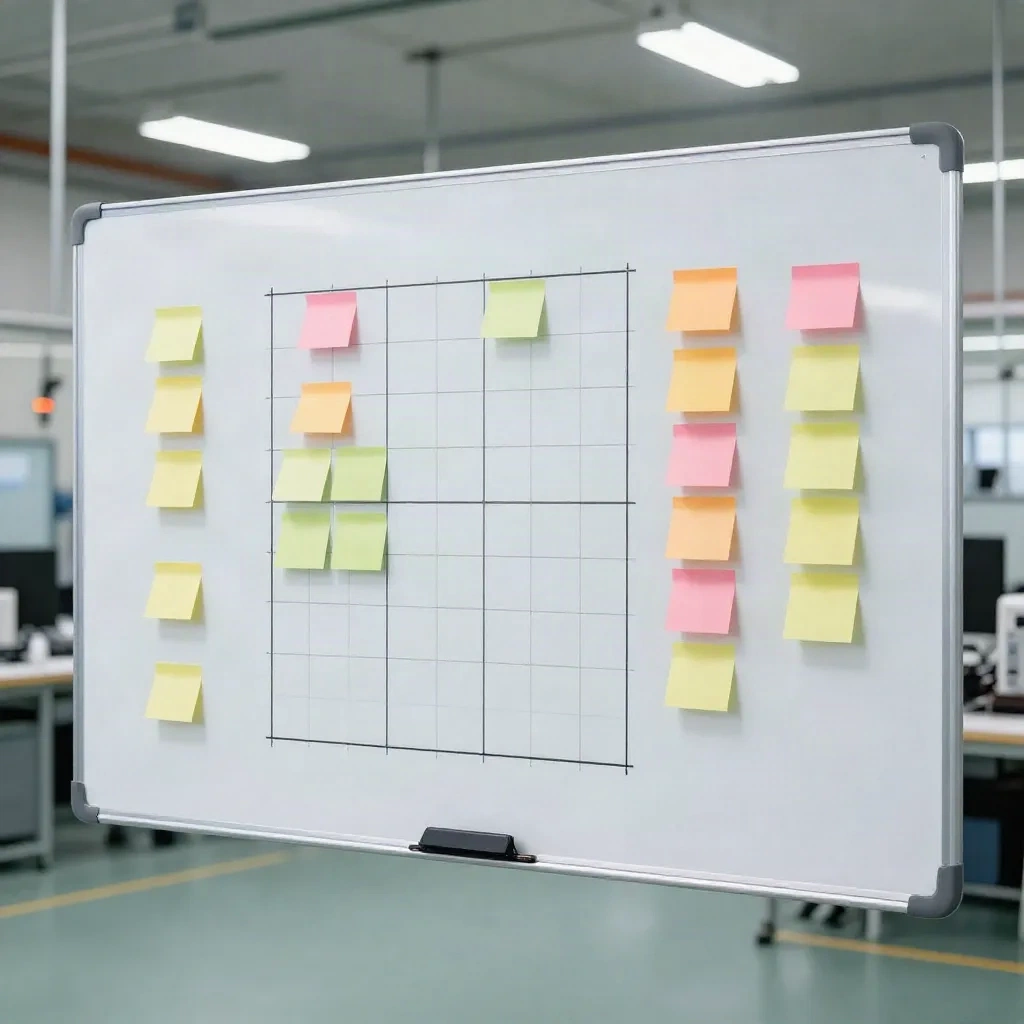
If a kaizen event generates more than twelve action items, the root cause has not been resolved. It has been listed. Effective kaizen minutes close with a single priority action that changes throughput or OEE (Overall Equipment Effectiveness, the ratio of actual to theoretical maximum production output) within 72 hours. Everything else is sequenced behind it.
Template 3 : Shift handover log: structure that prevents the next bottleneck
The shift handover is not a meeting in the traditional sense. But teams that run it as a five-minute face-to-face checkpoint with a written output get the accountability of meeting minutes with the brevity of a production log. Information that does not transfer between shifts creates the conditions for the next bottleneck.
WIP status: Unit count at each station at end of shift, any queue depth above normal operating range
Equipment status: Any asset running below rated capacity and estimated return to normal
Open actions from prior shift: Owner, status change if any, revised deadline if applicable
Anomalies: Any reading outside control limits and the immediate response already taken The format that works in practice: a three-row table. Row one covers the outgoing shift summary (WIP position and throughput achieved). Row two lists issues flagged (equipment, quality, safety). Row three records actions explicitly handed over with named owners and deadlines.
Teams using a shared digital form instead of paper report faster handover. The incoming shift lead reviews on a tablet while walking the floor. Response time to flagged anomalies drops from over 40 minutes to under 15 minutes in documented cases at distribution centers using structured handover logs.
Template 4 : Root cause review minutes: preserving the 5 Whys
Root cause review meetings generate insight and then lose it. Six months after a thorough 5 Whys session on a recurring downtime event, the same team runs the same analysis because the original session was not captured in a retrievable format. The minutes template for root cause work must preserve the chain of reasoning, not just the conclusion.
Event description: Machine, date, time, duration, and units or capacity lost, all quantified
5 Whys chain: Numbered, with evidence at each step: measurement or observation, not assertion
Root cause statement: One sentence, no ambiguity
Corrective action: Immediate fix, owner, and deadline
Preventive action: Systemic change, owner, deadline, and verification date
Verification: How and when confirmation that the countermeasure worked The preventive action row is the one most often left blank. If your root cause reviews close without a systemic fix and a scheduled verification date, expect the same event to recur within 90 days. The 5 Whys is only useful as a method if the fifth answer generates a permanent countermeasure.
Template 5 : Monthly OEE review: when data leads, discussion follows
The monthly OEE review is the one meeting where the data should arrive before the discussion begins. If attendees see the OEE trend for the first time when the slide appears, the first 20 minutes are consumed reading numbers instead of deciding what to do about them.
OEE trend: Availability, Performance, and Quality rates for the period, with prior period comparison
Loss ranking: Pareto-ranked categories: planned downtime, unplanned downtime, speed losses, quality losses
Prior month actions: Status for each item opened last session: closed, in-progress, or escalated
Decisions this session: Owner and deadline for each item decided
Pre-read for next session: Data set to distribute 24 hours before the next review A well-structured OEE review runs in 45 minutes when data is prepared in advance. If yours consistently runs 90 minutes, the bottleneck is data preparation, not discussion. Sending the pre-read 24 hours before the session reclaims that time without reducing the quality of decisions made.
How AI transcription tools change what you log : and what they still miss
AI meeting tools automate the transcript. They do not automate the interpretation. In ops contexts, the gap between what was said and what belongs in the minutes is significant. A transcript that captures "we need to address the conveyor speed issue" provides no value without the owner, target metric, and deadline that followed three conversational turns later.

The workflow that works in practice: run automatic transcription for every meeting, then have one person spend five minutes reviewing the output and tagging action items with owner and deadline. Total documentation time per meeting drops from around 25 minutes to under 8 minutes. The AI reads the result and surfaces candidates for action items. The ops lead validates each one into a named action with a deadline.
Fathom and Fireflies handle group audio reliably and integrate with most calendar tools. Otter.ai has stronger integration with recurring meeting workflows, which matters when your team runs five or more structured reviews per week. None of these tools replace the step where a human applies ops context to turn a transcript line into a named corrective action with a deadline.
When the meeting schedule is the bottleneck
Little's Law applies to meetings directly. WIP (Work in Progress) equals Throughput times Cycle Time. Substitute open action items for WIP, items closed per week for Throughput, and days from assignment to close for Cycle Time. If your average action item takes more than ten days to close, the constraint is not your minutes template. It is the number of open items competing for attention at the same time.
A meeting minutes template improves closure rate only when it creates visible accountability. If the minutes go out but no one reviews them before the next session, the accountability loop is not closed. The fix costs no additional time: open every meeting by reviewing the action list from the prior session. If that review takes more than five minutes, several items should already be closed before the meeting starts.
If your OEE review consistently runs over 60 minutes, start next month with a pre-read: distribute the data 24 hours before the session. The meeting becomes a decision session, not a data review. That single change typically cuts meeting duration by 30 percent without reducing decision quality. Start there before adding more meeting structure.