How to Take Notes From a Textbook Without the Stall
Summary
To take notes from a textbook, survey the chapter, turn each heading into a question, read one section, close the book and answer in your own words. Use a Cornell layout so the page doubles as a self-test, then review at one day, two days and one week. Time reading, writing and recall per section to find the limiting step. Usually it is copying, not reading.

Here is how to take notes from a textbook without turning a 30-page chapter into a three-hour slog: read one section, close the book, write the answer to one question in your own words, then move on. Treat the chapter as a pipeline with a limiting step. For most students, that step is not reading speed. It is the moment between "I read it" and "I can say it without looking."
Sunday night, 9 p.m. A student has a 40-page chapter due for Monday's quiz. Two hours in, she has highlighted most of it yellow and remembers almost none of it. The pages moved through her eyes at good speed. Nothing was stored. This is a classic case of throughput measured at the wrong station.
Why does highlighting feel productive and still fail?
Throughput (units completed per hour) only counts finished units. A highlighted page is not a finished unit, because nothing on it has been tested. It is work-in-progress (WIP, the stack of half-done items sitting between steps), and WIP piles up exactly where a process has a hidden limit.
The research backs this up. A widely cited review of ten study techniques rated practice testing and distributed practice as high utility, and highlighting and rereading as low utility, even though students report using highlighting and rereading most. The review's own advice is blunt: practice testing instead of rereading.
So the first skip is the obvious one. Skip the highlighter as your main tool. Keep it, if you must, for marking where a question lives, never as the note itself.
What is the bottleneck when you read a chapter?
A bottleneck (the station that caps the output of the whole line) in reading is rarely the eyes. Run a simple stopwatch test on your next chapter and log three times per section: reading time, writing time, and recall time, meaning how long it takes to say the main idea with the page closed.
Here is a typical pattern for a dense economics or biology chapter:
Reading a section: 6 minutes, fast and comfortable.
Copying notes from the page: 9 minutes, slow and mostly mechanical.
Recalling the idea with the book closed: it fails, so you reread, which adds another 6 minutes.
The limiting station is copying. It eats the most time and produces the least learning, because transcribing wording from the page does not force you to process meaning. The fix is to attack that station, not to read faster.
That timing log is the same input an AI analysis badge on a bottleneck calculator wants: stations, minutes per unit, and a verdict on which one caps the line. Enter reading, writing and recall minutes per section. The AI reads the result and tells you where the capacity is leaking. You do not need a factory to use the logic.

How should you prepare a chapter before you write anything?
Spend five minutes on a survey. Read the headings, the bold terms, the chapter summary and any end-of-chapter questions. Then turn each heading into a question: "Why does the heading say 'Marginal cost rises'?" becomes "Why does marginal cost rise as output grows?"
This is the first two letters of SQ3R (Survey, Question, Read, Recite, Review), a method that has been taught for decades. You do not need to follow it to the letter. The useful part is that you arrive at each section with a question to answer, so your notes become answers instead of copies.
Write the questions in the margin of a notebook page, not in the textbook. They become the cue column in the next section. If a heading does not turn into a question easily, that is a signal. Either the section is a definition list, which you will handle with flashcards, or you do not yet understand the chapter's structure and should survey again.
Which note layout works best for a textbook?
For textbook reading, the Cornell note-taking system is the most practical layout we know. You divide the page into a narrow cue column on the left, a wide note column on the right, and a summary strip at the bottom. The cue column holds your questions. The note column holds short answers. The summary strip holds one or two sentences after you finish the page.
Its strength is that the page doubles as a test. Cover the right column, read a cue, and answer out loud. That one habit moves your effort from the low-utility station (rereading) to the high-utility one (retrieval, pulling an answer out of memory).
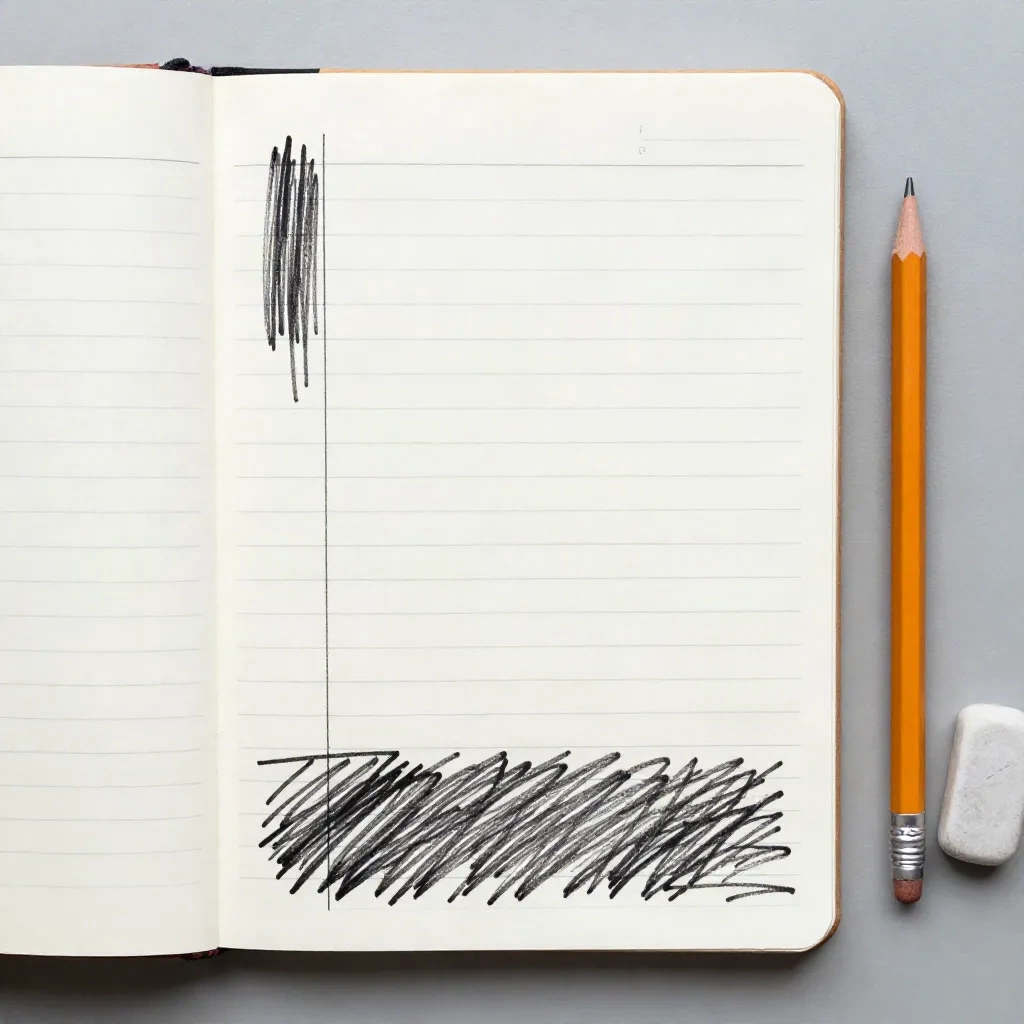
Worth it if you study dense, concept-heavy material like physiology, law or statistics. Skip it for formula-heavy courses where the content is worked problems. There, copy the problem types and write the first step you would take, then solve fresh examples without the book.
What does a good note actually contain?
A good note is short, in your words, and attached to a question. Aim for roughly one note per 300 to 400 words of source text. If your notes run longer than a quarter of the original section, you are transcribing, and the copying station is back in control.
Use this quick filter on every line you write:
Can I say it without looking? If not, it is not a note yet.
Does it answer the cue? If not, move it or delete it.
Is there a number or example attached? Dense text sticks to concrete cases.
Formulas deserve their own treatment. Write the formula, define every variable, and add one worked example. Little's Law tells us WIP = Throughput x Cycle Time, and a note like "WIP = 12 tickets, throughput = 3 tickets per day, so cycle time = 4 days" is far more useful than the formula alone.
Should you write by hand or type?
It depends on what the note is for. Typing is faster, which means you tend to transcribe. Handwriting is slower, which forces you to compress. For conceptual chapters, compress. For reference material you will search later, typing wins because search is a real advantage.
A practical split: write the first-pass notes by hand in the Cornell layout, then keep a typed version of only the cue-and-answer pairs you plan to review. If you read on a screen, a read-it-later app with highlights export can save you from copying passages by hand, and tools like Readwise Reader fit that job. Do not let the tool become the new bottleneck, though. Exporting 200 highlights is still WIP, not learning.
How do you review without rereading?
Review is where the pipeline pays off, and it is the step most students skip. Use spaced retrieval (revisiting a question at growing gaps) rather than a single cram:
Same day: cover the note column and answer each cue once. Takes about 10 minutes per chapter.
Two days later: answer only the cues you missed.
One week later: answer the missed ones again, then write a three-line summary of the chapter from memory.
Anything you miss twice goes on a flashcard. Anything you answer correctly three times in a row leaves the pile. You are managing a queue, and the queue should shrink.
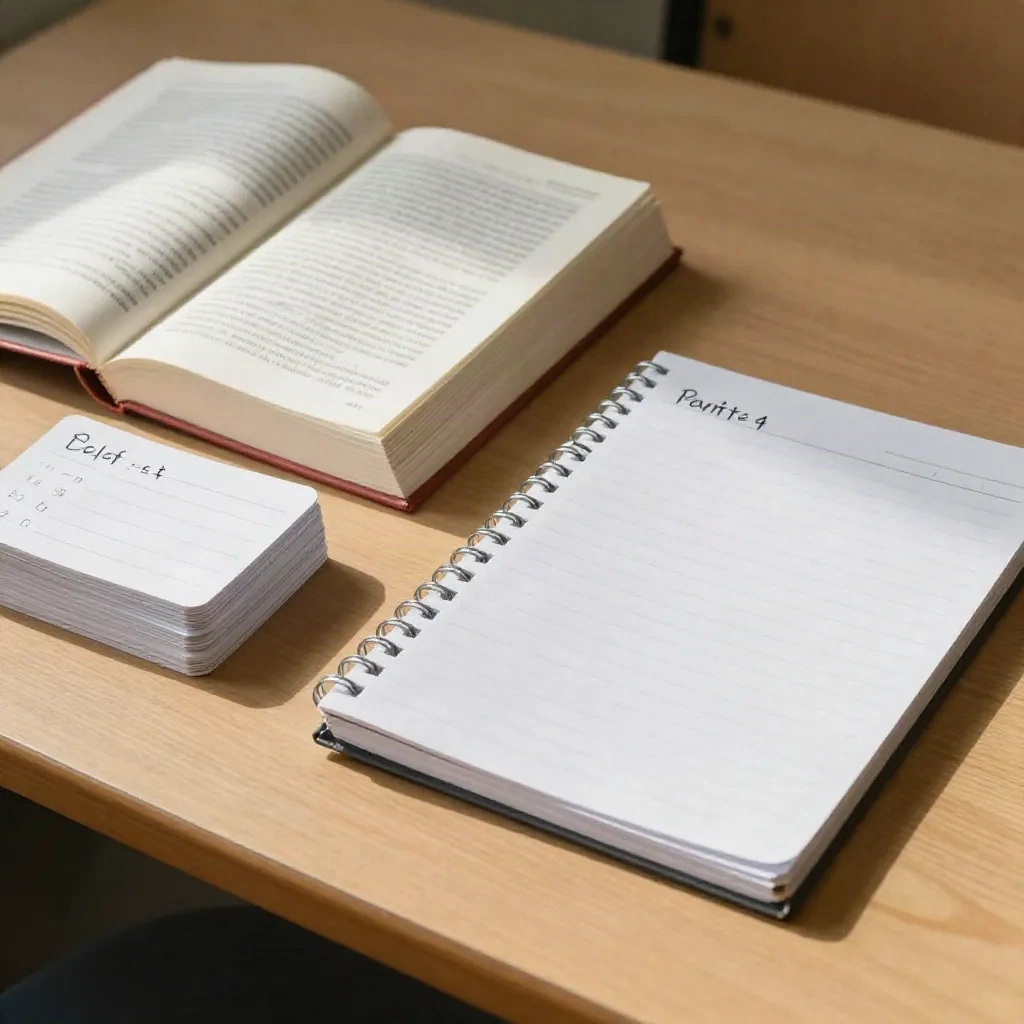
If you want a place to keep the cue-and-answer pairs, a general workspace such as Evernote or the database view in Notion works. The tool matters far less than the rule: no new note without a question, no review without covering the answer.
When should you skip taking notes at all?
Not every page earns a note. Introductory anecdotes, repeated examples and sidebars that restate the main text can be read once and left alone. A good test is the end-of-chapter question set: if you can answer it cold, the section does not need a note. If you cannot, it does.
Skip notes as well when the material is a worked-problem chapter you will redo anyway. Mark the problem numbers you got wrong and solve them again two days later. In a support queue, the equivalent is not documenting tickets that close on first contact. You document the ones that bounce between teams, because those are where the delay lives.
Be honest about the opposite failure too. A student who takes no notes and rereads is running a line with no quality check. A student who writes a note for every sentence is running a line with a buffer the size of the warehouse. Both look busy. Neither is converting reading time into recall at a decent rate.
What does a realistic time budget look like?
A realistic budget for a 30-page chapter at a first-year university level looks like this:
Survey and cue questions: 10 minutes.
Read and write answers, section by section: 75 to 90 minutes.
Same-day recall pass: 10 minutes.
Spaced reviews: three passes of 5 to 8 minutes each.
That is roughly 2 hours of first-pass work against the 3 or more hours the highlight-and-reread approach often burns, and you walk away with notes that are testable. Treat these as starting numbers and log your own. If one station stays above 40 percent of the total, that is your next limiting step.
A calm note on this: a slow station is not a failure. It is a signal. The aim is to find it, move effort to it, and measure again next chapter.
What would we actually do tomorrow morning?
Pick one chapter. Survey it for five minutes and write the cue questions. Read one section, close the book, answer one cue in your own words, then repeat. Keep a stopwatch beside you and log reading, writing and recall minutes per section.
After three sections, look at the numbers. If writing dominates, shorten your notes. If recall fails, shrink the section size and read less per pass. If reading dominates, you probably picked a chapter that is too hard for your current background and need a primer first.
If your recall minutes sit above your reading minutes, start there: smaller sections, one question each, answer before you move on.