How to Summarize a Book: Find the Step That Stalls You
Summary
To summarize a book, read with a filter, export your highlights, compress them in two passes, outline the argument, then write from memory and check your notes. Time each step once on a short book. The longest is your bottleneck, the station that caps the whole pipeline. For most readers it is compression, where batching by chapter and an AI first draft save hours. Keep the final memory step human, so you can vouch for every claim.
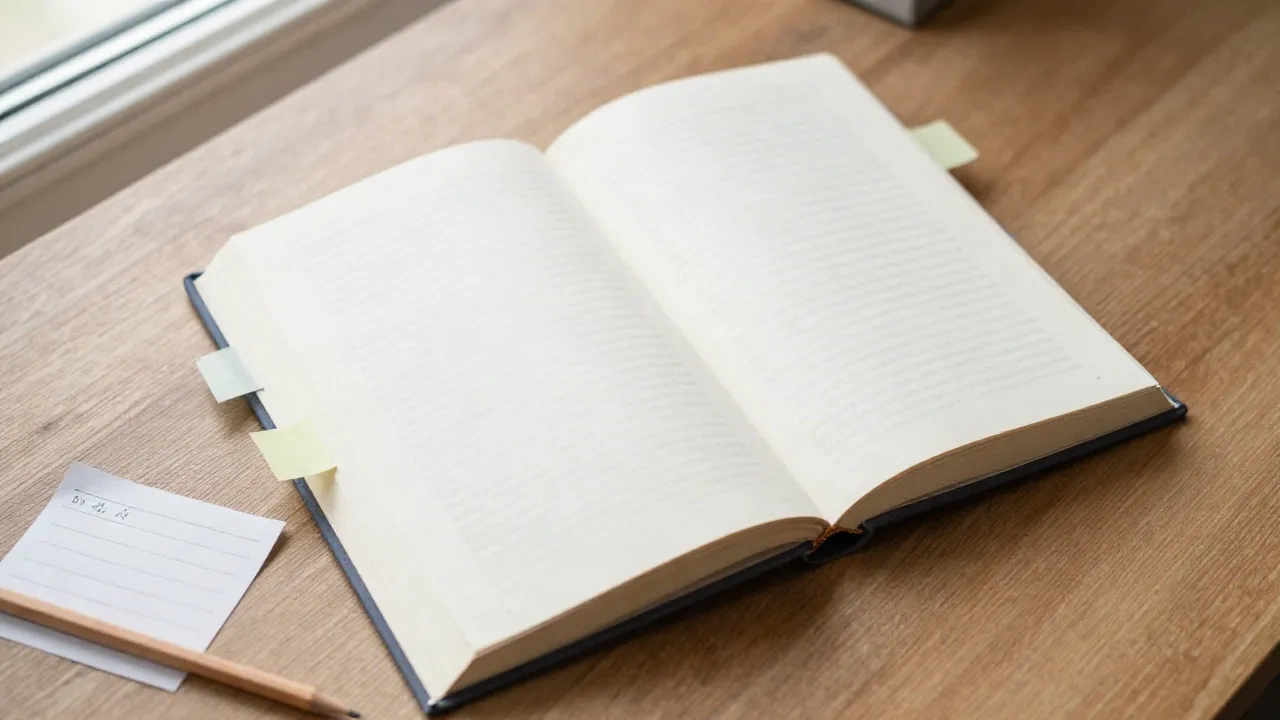
How to summarize a book comes down to five steps: read with a filter, export what you marked, compress it in passes, outline, then write from memory. The step that decides how long the whole thing takes is almost never the reading. It is the one where you stall, and fixing that single step beats speeding up the others.
Picture a line with five stations. If the third station handles 4 units an hour and the rest handle 10, the line ships 4 an hour, whatever the others do. Book summaries work the same way. Most people pour effort into reading faster, then lose a weekend staring at a blank page.
Why does a book summary stall at one step?
A bottleneck (the station that caps the output of the whole line) shows up in knowledge work exactly as it does in a plant. Your summary pipeline has stations: read, mark, extract, compress, outline, write. Each has its own cycle time (minutes of work per unit of output).
Little's Law gives a quick sanity check on where work piles up:
WIP = Throughput x Cycle Time
WIP        = items waiting in the pipeline (unprocessed highlights, chapters)
Throughput = items finished per hour
Cycle Time = hours an item spends in the pipeline
If you finish 6 chapters in a weekend but 40 highlights sit unsorted, your WIP (work in progress) is high and the queue sits in front of the compress step. Reading was never the problem. That queue is the signal, and it is a calm one: it tells you where to put your next hour.
The same logic is what the AI analysis badge does in our calculators. You enter your station times, and it reads the result and names the limiting step in plain language. You can run the same check by hand on your reading pipeline with a stopwatch and one sheet of paper.

What are the five steps to summarize a book?
Each step has its own cycle time, so read them with a stopwatch in mind.
Step 1: Read with a filter, not a highlighter habit
Decide before chapter one what the summary is for. A summary for a book club needs plot beats and themes. A summary for work needs the claims you could act on. A summary for an exam needs the author's argument and evidence. Three purposes, three different filters.
Then mark less. The method laid out in Tiago Forte's guide to summarizing books is blunt about this: highlight chapter titles, lists and summaries the author already wrote, and skip whole paragraphs and ideas you already knew. Marking a full page creates sorting work later, and that work lands on the station that is already slowest.
A workable cap is one highlight per page on average. A 300-page book then gives you around 300 marks, which is a pile you can still process in one sitting. Skip this rule if you read fiction for a class, where nearly every scene can matter.
Step 2: Export your marks before you do anything else
Get your highlights out of the book and into one text file the same day. Kindle, Apple Books and read-it-later apps all export. Paper readers can photograph the tabbed pages and transcribe only the marked lines.
This step is fast, usually 10 to 15 minutes, so it is rarely the limiter. Its job is to give you one place where the whole book lives in your own words and the author's quotes. Everything after this works on that file, not on the book.
If you keep your notes in a tool like Notion or Obsidian, paste the export under a heading for the book and keep chapter titles as sub-headings. Structure survives, and the outline step gets easier.
Step 3: Compress in passes, and stop after two
Progressive summarization means you shrink the same text in layers. Pass one: bold the strongest lines from your export. Pass two: highlight the best of the bold. Each pass cuts the text roughly in a third to a half.
Most people over-do it. A third pass produces a few fragments that no longer make sense without the book. Stop at two passes unless the book is very dense.
This is the step where most summaries stall. Compressing needs judgment on every line, so its cycle time per highlight is the longest of the pipeline: say 30 to 45 seconds each in an illustrative run, against 3 or 4 seconds per highlight to export. At 300 highlights that is two to three hours on this station, against under an hour for everything before it.
Here is the practical read of those numbers. If compression is your limiting station, three fixes beat reading speed:
Cut the input. Fewer highlights in step one means less queue here.
Batch by chapter. Compress one chapter's marks at a time so the queue never grows past 30 or so items.
Offload the first draft of the compression to an AI model, then edit it (more on that below).

Step 4: Outline in the shape of the argument
Outlining is where a pile of lines becomes a summary. Pick one of two shapes and stick to it.
For nonfiction, use claim, evidence, so what. Each section of the outline holds one claim the author makes, the best evidence for it, and what it means for the reader. Five to eight claims cover most business and self-help books. A summary with 15 claims is a table of contents.
For fiction, use setup, turning points, resolution. Name the protagonist's want, the three or four events that force a change, and how it ends. Decide up front whether your summary is allowed to spoil the ending. For a class report it usually is, for a recommendation to a friend it is not.
Write each heading as a full sentence. "Habits beat goals because systems keep running when motivation drops" is a heading you can write a paragraph under. "Chapter 4: Habits" is not.
Step 5: Write from memory, then check against the notes
This is the step many guides skip, and it is the one that makes the summary yours. Close the book and the notes. Write each section of the outline from what you remember. Then open the notes and fix what you got wrong or left out.
The reason is backed by cognitive science. Retrieval practice, the act of bringing information to mind without looking at it, boosts learning more than rereading and re-reviewing, according to a body of research that spans more than 100 years. A summary written from memory doubles as a test of whether you took the book in.
Aim for a summary that is about 1 to 2 percent of the book. An 80,000-word book gives you 800 to 1,600 words, which is the length of a good one-page brief. Shorter than that and you lose the evidence. Longer and nobody reads it.

Can AI summarize a book for you, and where does it help?
AI is good at one station of this pipeline and weak at two others. It compresses well, it extracts structure well, and it is poor at deciding what matters to you and at the memory step.
Paste a chapter's highlights into a chat model and ask for the claim, evidence and implication for each section. A tool like Claude, with its long context window, can hold a whole exported highlight file at once. ChatGPT works the same way and adds tools for follow-up questions. Notion AI summarizes pages in place if your notes already live there.
The risk is the same as with any machine in a line: unattended output drifts. A model asked to summarize a book it has not been given will invent chapter contents with full confidence. Feed it your own highlights or the actual text, and check every claim you plan to keep against the page.
Our rule: use AI for step 3 and as a sparring partner on step 4, and do step 5 yourself. If you hand over all five steps, you move the bottleneck rather than remove it. It lands on verification, and you now hold a summary you cannot vouch for.
Which steps should you automate first?
The honest answer depends on where your own clock says you stall. Time each station once on a short book, 150 pages is enough, and write the minutes down.
Here is how to read your result:
If reading takes more than half the total, you are probably over-highlighting or reading a book that should have been skimmed. Tighten the filter in step 1.
If compression takes more than half, batch it by chapter and bring in an AI first draft.
If outlining takes more than half, your highlights lack structure. Go back and keep the chapter headings in the export.
If writing takes more than half, you are writing from the notes instead of from memory, and polishing as you go. Set a 45-minute timer for the first draft.
An illustrative split for a 300-page nonfiction book is 5 to 7 hours for reading, 1 hour for marking and export, 2 hours for compression, 45 minutes for the outline and an hour for writing. Your numbers will differ. What matters is which one is largest, because that is the one worth working on.
When is a one-line summary enough?
Not every book earns the full pipeline. Skip the five steps and write three sentences if the book is a reference you will consult rather than read, if it repeats one idea for 250 pages, or if you only need to decide whether to read it.
For those, try the one-paragraph test: what does the author claim, what is the best evidence, and what would you do differently because of it? If you cannot answer in a paragraph after reading the introduction and the final chapter, you either need the full method or you picked the wrong book.
What to do this weekend
Pick a short book you already own. Time each of the five stations with a phone stopwatch. Whichever one takes longest is your limiting step, so spend your next session improving only that one. If your numbers are, say, 90 minutes of compression against 20 minutes of everything else, start with batching and an AI first draft.
Run it again on the next book and compare. A pipeline that drops from 9 hours to 6 on the second pass has found its constraint. Enter your numbers, then act on the step they point to.