AI Agent Examples That Cut Real Operational Bottlenecks
Summary
AI agents are autonomous systems that observe a process, evaluate options, and act without waiting for human approval on each step. Unlike simple automations, they handle the variance: the exceptions and edge cases where queues form and throughput stalls. This article maps six AI agent deployments to the specific bottleneck each one cleared, with documented throughput gains from manufacturing lines, logistics centers, support queues, healthcare claims, software pipelines, and procurement workflows.
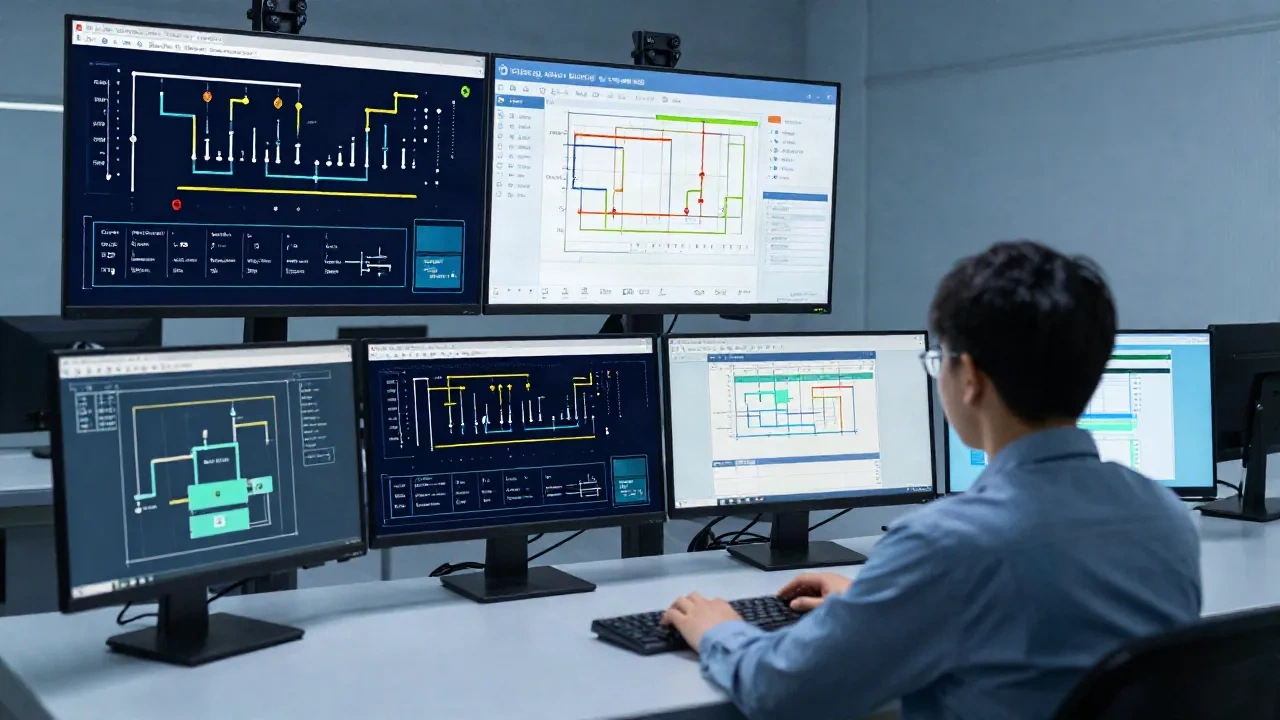
The best real-world ai agent examples share one thing: each agent was deployed at a specific process bottleneck, not at an arbitrary step. An assembly line with six stations moves at the pace of its slowest station. A software release cycle, a claims processing pipeline, and a customer support queue follow the same logic: one step dictates throughput for everything above and below it.
AI agents - autonomous systems that observe data, reason about it, and take action without constant human approval - are now being deployed specifically at these limiting steps. Not as dashboards. Not as reports. As active participants in the workflow that identify the constraint and clear it.
Here is what six documented deployments look like, with measured outcomes you can benchmark against your own numbers.
What Separates an AI Agent from a Simple Automation
A rule-based automation follows a fixed script: if condition A, do B. It breaks the moment A changes shape or a new exception type appears. An AI agent does something different: it reads context, weighs options, selects an action from a range of possible moves, and escalates to a human only when its confidence score drops below a defined threshold.
The distinction matters directly for bottleneck analysis. A fixed automation handles the normal case efficiently. An AI agent handles the variance: the exception, the edge case, the routing ambiguity that used to create a queue because no rule covered it cleanly. That queue is typically where the real constraint is hiding.
Applied to the Theory of Constraints (ToC) framework, developed by Eliyahu Goldratt: every system has one poste limitant (the step that sets the ceiling on the throughput of the entire pipeline). An AI agent deployed at that step does not merely speed it up; it changes the capacity curve and shifts the constraint downstream to the next limiting step.
Simple automations reduce labor at steps that are not bottlenecks. AI agents reduce cycle time at the step that is.
Manufacturing: Catching the Limiting Station Before It Stalls the Line
A precision parts supplier running an eight-station CNC assembly line found that station 5 was responsible for 73% of unplanned downtime, despite consistently reporting an OEE (Overall Equipment Effectiveness, a composite metric that multiplies availability, performance, and quality rates) above 74%.
The problem: the OEE figure masked micro-stoppages of under two minutes each, too short to trigger an alarm, long enough to accumulate across a shift. An AI agent connected to the SCADA (supervisory control and data acquisition) system began monitoring vibration signatures and cycle time deviation in real time. When a pattern associated with an upcoming micro-stoppage was detected, the agent pre-scheduled a technician pass and reduced the upstream feed rate to prevent WIP (work in progress, the total volume of units in process at any moment) from accumulating at station 5.
Results over 12 weeks: average station-5 cycle time dropped from 4.2 to 3.7 minutes. Line throughput increased by 11 units per hour. No added headcount. The agent gave the technician 40 minutes of advance notice instead of zero seconds of warning.
The OEE number alone would not have surfaced this problem. The agent acted on signal the standard metric was smoothing away.

Logistics: Closing the Demand-Forecast Gap in Inventory Replenishment
Distribution centers run on replenishment cycles. The classic bottleneck is the gap between demand signal and purchase order: a buyer reviews sales trends, confirms stock levels, gets finance sign-off, and sends a PO. In fast-moving SKU environments, that cycle runs three to five business days.
At a regional food-service distributor supplying 200 restaurant accounts, an AI agent was given access to point-of-sale data, supplier lead times, and upcoming reservation calendars. The agent generates draft POs automatically when projected stock hits a reorder threshold, routes them for one-click buyer approval when within pre-approved spend parameters, and escalates only the outliers requiring judgment.
Measured outcomes: cycle time from demand signal to approved PO fell from 3.8 days to 6.4 hours. The buyer's workload shifted from generating orders to reviewing exceptions. Inventory carrying cost dropped 18% in the first operating quarter. Food waste from over-ordering decreased 12%.
The bottleneck was the human decision loop on routine transactions, not the availability of data. The agent closed the gap by removing the steps that required full human attention on each transaction regardless of whether that attention added value to that specific order.
Customer Support: The Ticket Routing Agent as WIP Controller
Support queues behave like any queuing system. Throughput equals the rate at which tickets are resolved, and WIP equals throughput multiplied by average cycle time. Little's Law in one line:
WIP = Throughput x Cycle Time
When cycle time rises because tickets sit in the wrong queue awaiting reassignment, WIP balloons and response times degrade across all customers. A B2B software company with four specialist support tiers found that 28% of incoming tickets were initially routed to the wrong queue, creating a secondary triage step that added 4.1 hours of average cycle time per misrouted ticket.
An AI agent trained on historical ticket text, resolution paths, and tier-specific metadata now handles initial classification. It reads each ticket, assigns a tier and a priority score, and routes directly. When confidence falls below 85%, it routes to a generalist tier and flags for human triage. Misrouting dropped from 28% to 3.4% in two months.
Average ticket cycle time fell from 14.2 hours to 9.8 hours. The agent resolved nothing. It removed the queue accumulation at the triage step, which was the actual throughput constraint. Ticket volume stayed the same; throughput increased because cycle time at the bottleneck step dropped.
Healthcare Claims: From a 15-Day Cycle to Under 48 Hours
Healthcare claims appeals offer one of the most clearly documented AI agent deployments in public reporting. A US health system's appeals process averaged 15 to 16 days from denial receipt to corrected submission. The bottleneck was clinical documentation assembly: a nurse had to read each denial letter, locate the relevant records in the EHR system, assemble a corrected claims package, and route it for approval.
An AI agent was deployed to read denial letters automatically, identify the required supporting documentation, retrieve it from the EHR, assemble the corrected package, and route the final file to the nurse for review and signature - not for assembly.
New cycle time: one to two days. The nurse's role shifted from documentation assembly (the bottleneck activity) to clinical judgment on a prepared package (the activity that genuinely requires professional expertise and cannot be delegated). Throughput on appeals per nurse per week increased approximately seven times.
The ops lesson: the bottleneck was not review capacity. It was documentation assembly capacity. Identifying that distinction, rather than simply hiring more reviewers, was what made the improvement possible. More nurses would not have moved the constraint.

Software Pipelines: CI/CD Agents That Clear the Release Backlog
Software engineering teams track deployment frequency as a DORA (DevOps Research and Assessment) metric. Top-quartile teams deploy multiple times per day. Most teams queue releases into batches because manual approval steps carry enough overhead to make frequent deployment economically inefficient.
The manual approval step is the constraint. An AI agent trained on test pass rates, code coverage deltas, performance benchmark results, and historical rollback data can issue a go or no-go recommendation for the majority of deployments. Human reviewers see only the flagged cases where the agent's confidence score falls below a configured threshold.
Engineering teams using this approach report a 40% to 60% reduction in deployment cycle time and a 30% increase in deployment frequency with no increase in production incident rates. The agent concentrates human review on releases where judgment adds the most value, and removes it from routine cases where it was adding queue time but not quality.
The formula translates directly to any approval-gated process in operations. If your review capacity is the constraint, the question is not how to review faster. It is what percentage of reviews actually require human judgment, and how to route the rest.
How to Map an AI Agent to Your Actual Constraint
The pattern across every case above is consistent. Before deploying an agent, the operations team had to answer three specific questions:
Where does flow stop? Identify the poste limitant: the station, queue, or decision loop where units, tickets, or requests accumulate. This is not always the step with the highest visible workload; it is the step with the lowest throughput relative to upstream supply. A WIP count by step, or a cycle time measurement by station, will surface it.
What is the decision logic at that step? Is it rule-based (routing by keyword or category)? Pattern-recognition-based (predicting equipment failure from sensor data)? Judgment-based (clinical review of assembled documentation)? The answer determines whether an agent can take over the step entirely, assist by preparing inputs, or only triage.
What is the escalation threshold? When does the agent defer to a human, what does that deferral look like operationally, and who receives the escalation? An agent without a defined escalation path creates a different kind of bottleneck: the case that no one owns.
Agents deployed without answering the first question tend to automate the easy steps, not the limiting ones. Throughput does not improve when you accelerate a step that is not the constraint.
A useful starting diagnostic: run your process through a throughput calculation using Little's Law. If WIP is high and throughput is low, cycle time at one specific step is the culprit. That step is where an agent earns its operating cost.
If your production operation has an OEE below 75% and losses concentrate in a specific equipment category or shift window, instrument that step first. Agents need signal. The first investment is often in the data layer, not the decision layer.
Start with the constraint. Build the agent around the bottleneck it needs to clear. Measure throughput before and after with the same metric you use today.